PaulaSwafford
Paula Swafford is the author of Cream City Elegy. She lives in Milwaukee, where her work returns again and again to the city and the working class lives that shaped it. Purchase here.
Background
Two hundred thousand years ago, the first people of North America possessed science, technology, and culture more advanced than those of Western civilization in 2020.
The Threat
They discovered that a great ice age was beginning—one that could destroy their civilization.
The Mission
In response, a team of leaders and scientists proposed exploring the galactic neighborhood to learn whether other beings or worlds might be able to help Earth.
The Story
This is the story of what they found and what they did when they returned.
Milwaukee, 1970. Ray Mercer carries his bride over the threshold of a house a single paycheck could buy, on a block where the plant is always hiring and the pool is free and a few steps from every door. He has done everything right, and he is sure he earned it.
Over the next half-century, the ground shifts beneath Ray and everyone he loves. The factories fall silent. A pension develops a hole one month wide. The children who do everything they are told inherit debt instead of a ladder. And a city built on the promise that hard work would be enough begins, one family at a time, to come apart —while the people inside it are told, again and again, that the fault is their own.
Sweeping across four generations and the long unmaking of a working-class city, Cream City Elegy gives its heart to the people the story of decline usually leaves out: the ones who stayed, who tended what was left, who were never the reason the ground gave way beneath them.
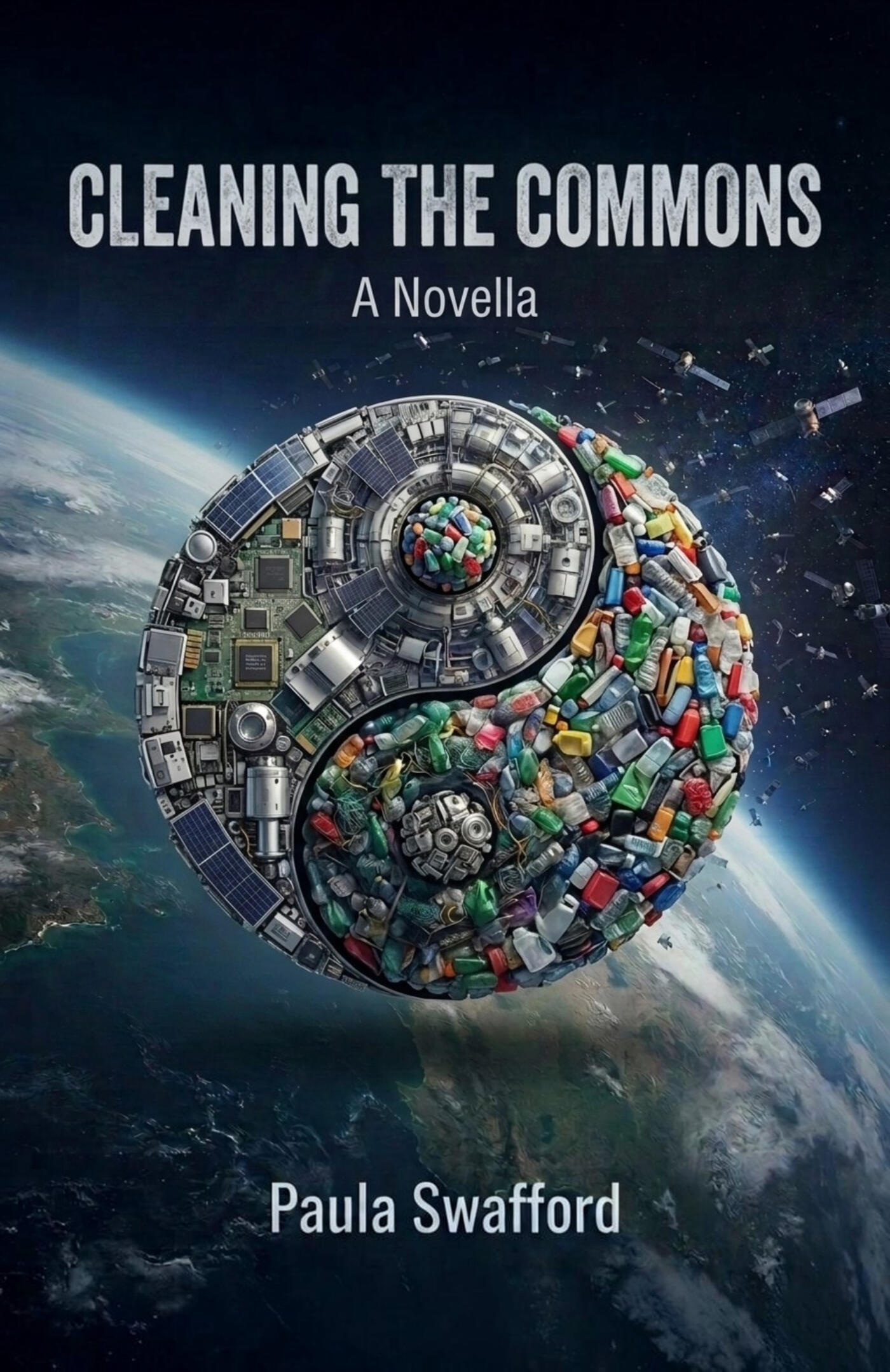
A dead satellite shatters in orbit. On a tidal river in Metro Manila, Maribel hauls the world's plastic out of the water every morning. Two commons — the sky and the sea — choking on the same discarded century, and no one required to pay for it.Cleaning the Commons follows four people who each see one face of the catastrophe: Maribel, on the barge; Sarah, a Senate staffer whipping votes for a tax on the wellhead; Aya, an analyst who watches the sky come apart and grasps, alone, what it means; and Tariq, a Gulf technocrat building his nation's future out of the very plastic filling Maribel's river.
As a cascade above and a storm below pull the strands tight, all four arrive at one unwelcome truth: you cannot mop faster than the tap runs. The question underneath every headline isn't whether we can clean the mess — but whether we can stop making it, and what we'll spend to try.
The women of a Milwaukee book club have been reading together for years. They read Austen and Forster and Ishiguro. They are careful, cultured, and generous, and they have never once been wrong about a novel.In November 2025 a shutdown in Washington empties forty-two million food-assistance cards overnight, and the club learns that the woman who cleans their houses cannot feed her children. So they do what gentle readers do. They carry groceries up her back stairs.Jovita is thirty-two, a citizen, a housecleaner, and the wife of a man who got on a bus to Mexico rather than let his children watch him taken off the street. She saw the zero coming eleven days out. She had a plan. It was never going to be enough. And she knows exactly what she is to the women standing in her kitchen.Told across three years in two voices - Jovita's, immediate and exact and never once looking forward; Carmen Tucker's, looking back at all of it and reckoning with what she got wrong - and interrupted by the machine itself, grinding eight hundred miles away in rooms with bad carpet, Gentle Readers is a novel about the distance between being helped and being seen, and about who gets read, and who gets to do the reading.